Move — Christian Tamburr
Analyzed and curated 2026-08-02. The MP3 audio payloads were not transcoded. Metadata, filenames, forensic JSON, and this report were updated; folder artwork and diagnostic images were retained.
Summary
This is a complete ten-track copy of Christian Tamburr's debut album, now ordered to match the artist's published sequence. The files are 128 kb/s CBR MP3, 44.1 kHz stereo. All ten decode successfully after retagging.
The artist's contemporary discography identifies the Christian Tamburr Quartet release as Tamburr Worldwide, 2004, and says it was recorded June 20, 2004 at WUCF Studios in Orlando, then recorded/mixed/mastered by John Marsden at Little Big Sound Studios. Tamburr's current biography instead calls Move a 2006 independent release. The report therefore treats 2004 as the best-supported original release year while preserving the official-site discrepancy.
Provenance confidence: official album program, personnel, recording session, and publisher are identifiable; the particular local MP3 source is not. No disc TOC, rip log, catalog number, barcode, or encoder signature survives.
Understanding the album
Move catches Christian Tamburr at the point when an unusually broad working education becomes a composer's first statement. He had already played drums, piano, percussion, and vibraphone; worked in Florida jazz and theater; and performed nightly in Las Vegas. The debut does not respond by displaying every possible instrument or enlarging the ensemble. It narrows the frame to a quartet and makes the vibraphone–piano relationship its main laboratory.
The title is apt without needing an undocumented program. The record keeps changing the way motion is generated: mallet attack against piano sustain, four-to-the-bar swing against waltz time, a compact blues against long-form solos, and Tamburr moving from vibraphone to piano on two tracks. This is not the mature summation of a settled style. It is a young bandleader learning which parts of his musical life can become his own book.
The accidental instrument that became the center
Tamburr's path to vibraphone was practical rather than mythic. He has recalled entering middle-school band as a percussionist because piano and guitar were not options. Once he reached jazz band, stronger drummers already occupied the chairs, so his director rolled out an unused vibraphone and told him to play it when he was not drumming. Tamburr became absorbed by the instrument and by recordings the director shared: Lionel Hampton, Milt Jackson, and the Terry Gibbs Dream Band.[1]
That origin matters to Move. Tamburr approached vibes from inside rhythm and from prior experience at the piano, not as a specialist encountering harmony for the first time. He later named Pat Metheny, Oscar Peterson, Gary Burton, and Chick Corea among his early inspirations, while identifying multi-instrumentalist Ira Sullivan as a crucial living mentor.[1] Those are documented influences. It would be too simple, however, to assign each track to one predecessor merely because a passage swings like Hampton or uses the instrument's sustained harmony in a way associated with Burton.
The album's quartet makes Tamburr's doubled background audible. Oscar Perez plays piano except on “The Waltz” and “Spaghetti and Meatballs at Sullies,” where Tamburr moves to piano; Elisa Pruett plays upright bass and Justin Varnes drums throughout.[2] On the vibraphone tracks, Tamburr is both a melodic front-line player and a second source of harmony. He must decide when to reinforce Perez, when to leave air around the piano, and when the metallic decay should behave more like a horn line than a chordal pad.
“Chief” and the beginning of composition
The opening track has the strongest documented origin on the album. Tamburr has said he struggled when first required to compose in college and stopped writing for a period. At about twenty-two, while performing nightly at the Bellagio with the Noel Freidline Quintet, he wrote “Chief.” It was the first piece of his that other musicians wanted to play. Hearing a band perform it for an audience gave him the confidence to continue writing.[1]
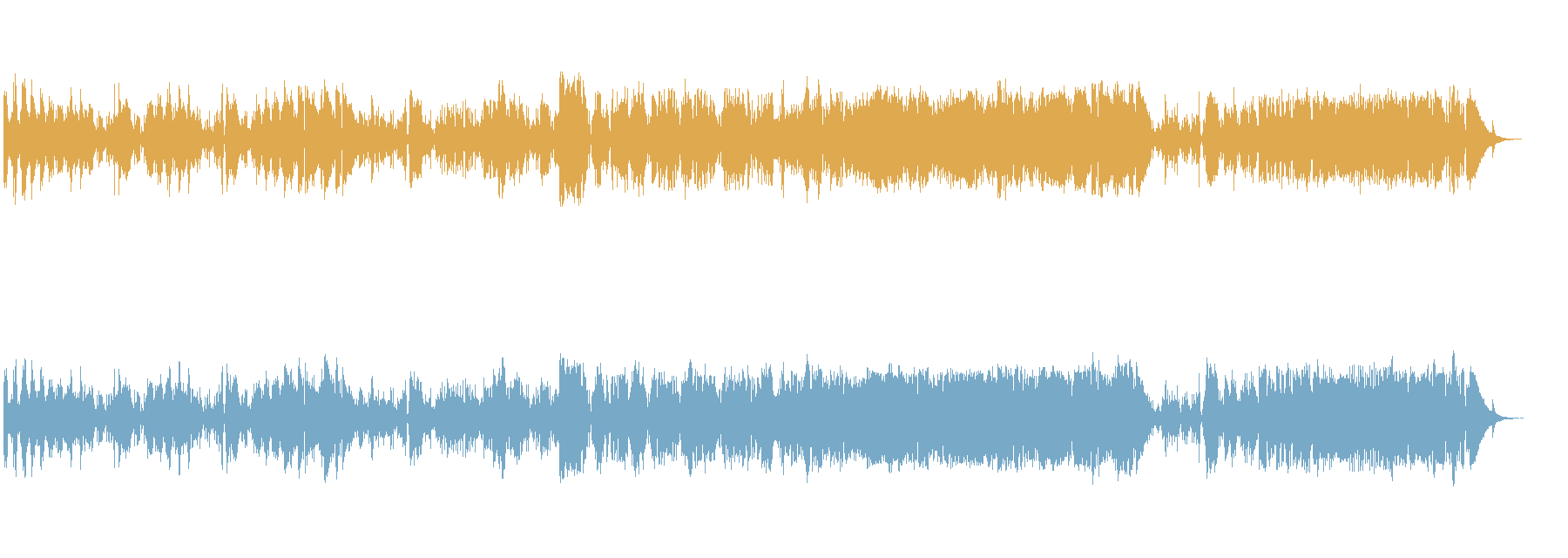
That makes “Chief” more than a confident opener chosen after the fact. It is a threshold composition: the point at which an accomplished young player began to believe his own material could survive in other musicians' hands. Its placement lets the debut begin with the event that made a debut imaginable. The local waveform shows an assertive, consistently high-level master, but the performance still retains 6.1 LU of measured range and space for quartet response.
No comparably reliable first-hand account was found for “Esquè,” “Softly,” “Blues for JO,” “Let Go,” or “Dae La.” Their titles are not enough to infer subjects, dedications, or writing circumstances. The music can be described: “Blues for JO” uses a compact blues language and is the densest track in the local mastering; “The Waltz” changes both meter-feel and keyboard ownership; “Dae La” is the longest original-titled performance and gives the quartet room to develop ideas over more than six minutes. Assigning stories beyond that would be invention.
A debut built from a working musician's life
By the time of Move, Tamburr's education was occurring as much on jobs as in school. Contemporary biographical material places him in the Noel Friedline Quintet at the Bellagio, in projects with Penn & Teller, and in Florida's jazz scene before the album.[3] He later described professional versatility in plain economic and musical terms: when work called for funk drums or classical vibraphone, he wanted to be able to say yes.[4]
That outlook helps explain why the album does not treat jazz tradition as a museum. “Taking a Chance on Love” and “That's All” put established song forms beside the group's newer material. They test the same quartet language against music the audience and musicians do not need to learn from scratch. The standards are not evidence that every original has a hidden biographical program; they provide common ground from which phrasing, touch, and ensemble choices can be judged.
Tamburr's two piano performances are equally important. They prevent the vibraphone from becoming a branding device repeated without question. “The Waltz” gives him direct control over the harmony and attack normally shared with Perez. “Spaghetti and Meatballs at Sullies,” at only 3:33, is also the album's striking technical outlier: approximately six LU quieter than the album median. Whether that level difference arose in tracking, mixing, mastering, or the unknown MP3 source is undocumented, but it makes the track feel like a smaller side room inside an otherwise forceful presentation.
The quartet session and what survives
Tamburr's archived album page is the best direct session record. It dates the recording to June 20, 2004 at WUCF Studios in Orlando and credits John Marsden with recording, mixing, and mastering at Little Big Sound Studios.[2] It also preserves the ten-track sequence and exact instrumental division. This is strong evidence for the event even though Tamburr's newer biography lists Move among releases from 2006 while his detailed discography calls it a 2004 Christian Tamburr Music release.[5]
A single stated recording day suggests a concentrated session, but it does not prove that every performance was completed live or in one take. No session log, track sheet, interview with Marsden, piano or vibraphone model, microphone plan, overdub record, or mastering notes were located. The quartet interaction sounds immediate, and the consistent personnel make live ensemble recording plausible, but the article cannot elevate plausibility into production fact.
The local copy also imposes a second production layer. Every track is a 128 kb/s MP3 with a spectral ceiling near 16 kHz, and the album is mastered at a very high average level for an acoustic quartet. All ten tracks reconstruct above 0 dBTP, with several above +2 dBTP. Some overs are a normal consequence of lossy decoding, but the consistently dense presentation is still part of what this copy delivers. It is not possible to tell whether the original CD shared exactly this limiting or whether some of it entered during an unknown encode or library-processing stage.
Reception and the record's quiet afterlife
No contemporaneous professional review of Move was located in sources reliable enough to anchor a critical-reception section. The artist's current biography says the album sold more than 80,000 copies and appeared in a nationwide Starbucks gift set.[5] That is a significant claim about reach, but it comes from Tamburr's promotional biography rather than an audited sales database or label report and should be read with that attribution intact.
The more securely documented legacy is developmental. The official discography places Move at the start of a continuing independent catalog, followed by Arrivals with Ira Sullivan in 2007 and later quartet, quintet, and collaborative records.[5] Tamburr eventually worked again with Pruett and Varnes, while his long relationship with Sullivan moved from aspiration and mentorship into recording. The debut therefore begins several threads rather than closing one: original composition, bandleading, alternating piano and vibraphone, and using a small jazz group as the stable center of a much wider professional life.
Later writers described the range in his playing through comparisons to Hampton's swing, Red Norvo's technique, and Cal Tjader's coolness.[3] Those comparisons help locate how listeners heard him, but they are not a substitute for the album's own achievement. Move is most persuasive when it sounds like a musician converting fluency into authorship—still carrying visible teachers and models, but beginning to write the pieces other people want to play.
What remains undocumented
The source record does not establish the writing history or meaning of nine of the ten tracks, the number of takes, the balance between written arrangement and rehearsal-room development, or the original mastering values. No independent chart, sales, or period-review archive was found. The contradictory 2004/2006 dates remain unresolved; the detailed session and discography page supports 2004 more strongly. Finally, the local MP3s cannot identify their CD or download source. A physical copy or verified lossless release would be needed to separate the original production from this encode's limitations.
Collection and integrity
- Audio files: 10; 52:21.305 total; 48.0 MiB.
- Format: MPEG-1 Layer III, 128 kb/s CBR, 44.1 kHz stereo.
- Strict FFmpeg decode: 10/10 passed.
- ID3: v2.4, with consistent 200×200 embedded artwork, iTunes Sound Check (
iTunNORM) data, and Windows Media private fields preserved from the prior tags. - Encoder identification: unavailable. The application tags show library processing, not whether the upstream source was a CD or download.
- SHA-256 hashes for every audio container are recorded in
ALBUM_FORENSICS.json.
Program and sequencing diagnosis
The local titles correspond to all ten songs on Christian Tamburr's official album page. The former 6–8 rotation has been resolved: Let Go is track 6, Dae La is track 7, and Taking a Chance on Love is track 8. Filenames and TRACKNUMBER values agree, and no song was removed or replaced.
The official personnel are Christian Tamburr on vibraphone and piano (piano on tracks 4 and 9), Elisa Pruett on upright bass, Justin Varnes on drums, and Oscar Perez on piano except tracks 4 and 9.
Codec and spectral analysis
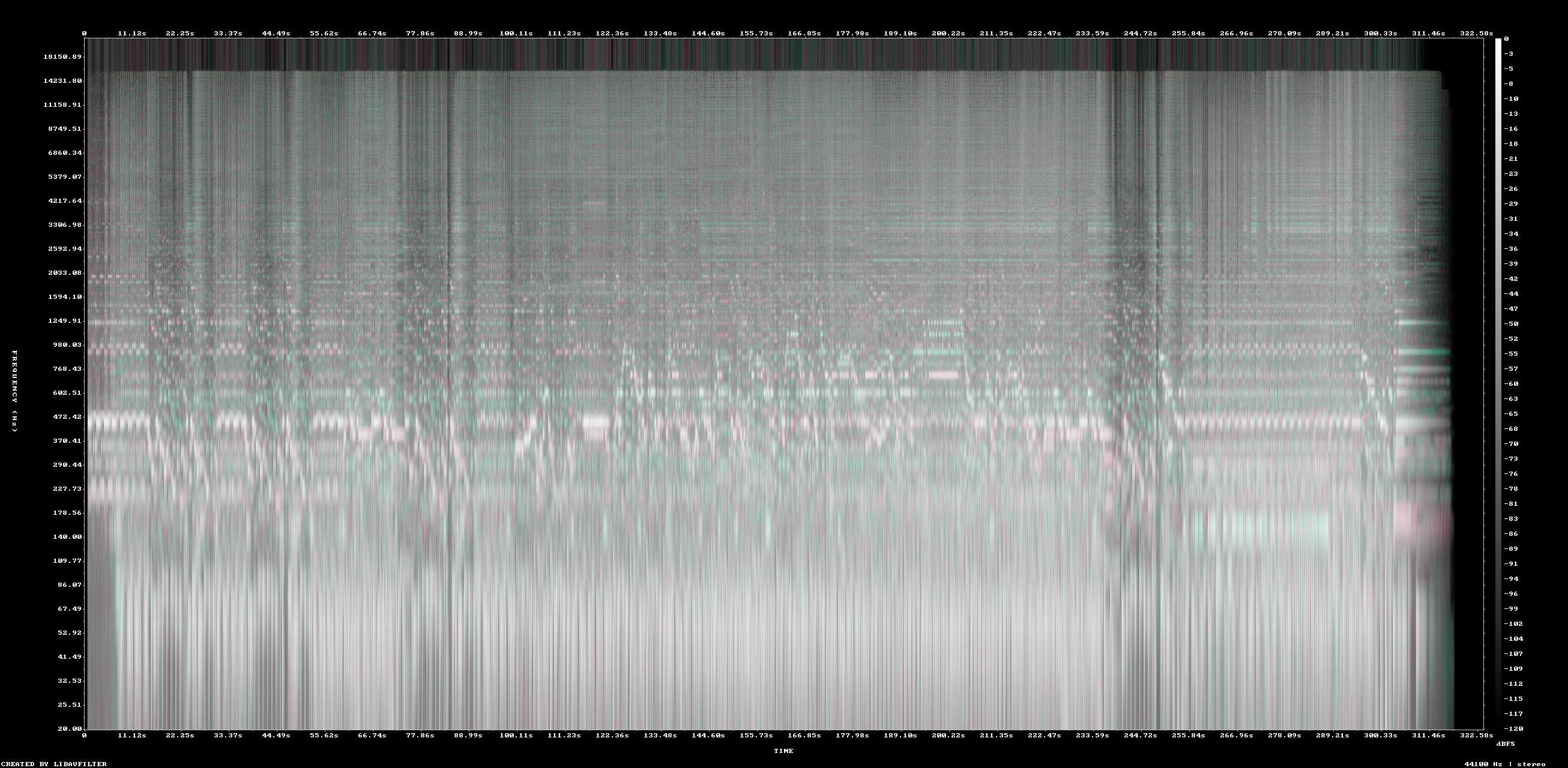
The representative spectrum has a conspicuous upper-band ceiling around 16 kHz, consistent with the declared 128 kb/s MP3 encoding. This is expected codec behavior and does not by itself prove a second lossy generation. Information already discarded by MP3 cannot be recovered by converting these files to FLAC.
Loudness and dynamics
| # | Track | Duration | LUFS | LRA | True peak dBTP |
|---|---|---|---|---|---|
| 1 | Chief | 5:23.979 | -7.54 | 6.1 | +1.52 |
| 2 | Esquè | 5:50.284 | -6.20 | 4.4 | +1.63 |
| 3 | Softly | 4:34.973 | -7.08 | 7.6 | +1.29 |
| 4 | The Waltz | 4:37.742 | -7.94 | 8.8 | +1.77 |
| 5 | Blues for JO | 5:07.365 | -5.38 | 3.1 | +2.33 |
| 6 | Let Go | 5:35.499 | -8.43 | 8.0 | +1.38 |
| 7 | Dae La | 6:22.911 | -8.05 | 5.6 | +1.65 |
| 8 | Taking a Chance on Love | 4:34.137 | -8.44 | 6.4 | +1.44 |
| 9 | Spaghetti and Meatballs at Sullies | 3:33.350 | -13.75 | 5.0 | +0.39 |
| 10 | That's All | 6:41.066 | -7.42 | 4.6 | +2.45 |
Integrated loudness spans −13.75 to −5.38 LUFS; the median is −7.74 LUFS. Median loudness range is 5.9 LU. This is a high-level, comparatively compressed presentation for an acoustic jazz quartet, although track 9 is about six LU quieter than the album median and retains a distinct level profile.
Every track reconstructs above 0 dBTP, reaching +2.45 dBTP. MP3 decoding can create overs even when the encoded source was sample-limited, so this is not proof that every overshoot is an audible clipped sample. It does mean playback or transcoding without headroom can clip. Preserve the files unchanged and use non-destructive ReplayGain/player attenuation if needed.
Stereo and signal health
Mean inter-channel correlation spans 0.291 to 0.576, consistent with stable stereo and no missing or consistently inverted channel. Maximum absolute measured DC offset is 0.000040. Strict decoding found no container errors. Separate invalid-sample counters were unavailable from this FFmpeg build.
Existing metadata
| Field | Current value |
|---|---|
| Album | Move |
| Album artist | Christian Tamburr |
| Track artist | Christian Tamburr |
| Date / original date | 2004 / 2004 |
| Genre | Jazz |
| Publisher | Tamburr Worldwide |
Completed metadata and curation
The sequencing, album artist, dates, publisher, track totals, genre, official title spellings, and track-level musician credits were applied on 2026-08-02. Embedded artwork and legacy application tags were preserved. The remaining optional action is acquisition: if this album matters to the collection, seek the original CD or a verified lossless purchase rather than transcoding this 128 kb/s copy.
Limitations
- No public disc TOC, package scan, secure-rip log, or lossless comparison was available.
- Spectral cutoff establishes codec behavior, not the number of lossy generations.
- True-peak reconstruction does not identify individual audible clipping events.
- No subjective listening comparison or known-master null test was performed.
Reproducibility
Measurements were made with FFmpeg/FFprobe 5.1.9 and tools/album_forensics.py: strict decode, SHA-256 hashing, ITU-R BS.1770/EBU-style loudness, true peak, −60 dBFS silence detection, sample statistics, and frame-level stereo correlation. The visual files use FFmpeg showwavespic and showspectrumpic.
| Artifact | SHA-256 |
|---|---|
ALBUM_FORENSICS.json |
88bd4690eedbecf59ad56957a2323900c8c3fe0a7b73743e7bd24212f9719179 |
cover.jpg |
ed3bb91192b48e394dffa22b4d4b49419045a8f3a36958eaf7e70fe10a85471f |
REPRESENTATIVE_WAVEFORM.png |
671f935adabbd4a5bca5109e7c62238faed63bc0cad712729ba570365c072d59 |
REPRESENTATIVE_SPECTRUM.png |
15a6d8f16a02ff6e843c4c8d03b94107dce38f64ea4baab1ae1e6e85316077c8 |
Sources
Published sources
- Christian Tamburr, interview by Dee Dee McNeil, “Boundless Creativity,” Modern Jazz Today, 2021. Interview
- Christian Tamburr, archived official CD page for Move: program, personnel, and session credits. Album page
- Bill DeYoung, “Good Vibes: Christian Tamburr,” Connect Savannah, October 6, 2009. Profile and interview
- Joseph Hayes, “A Musician on the Move,” Orlando Magazine, February 18, 2009. Profile and interview
- Christian Tamburr, official biography and discography. Artist site
- Christian Tamburr, official Move cover. Image
Local evidence
ALBUM_FORENSICS.json, generated from all ten local MP3 files on 2026-08-02.REPRESENTATIVE_WAVEFORM.pngandREPRESENTATIVE_SPECTRUM.png, generated from “Chief.”